
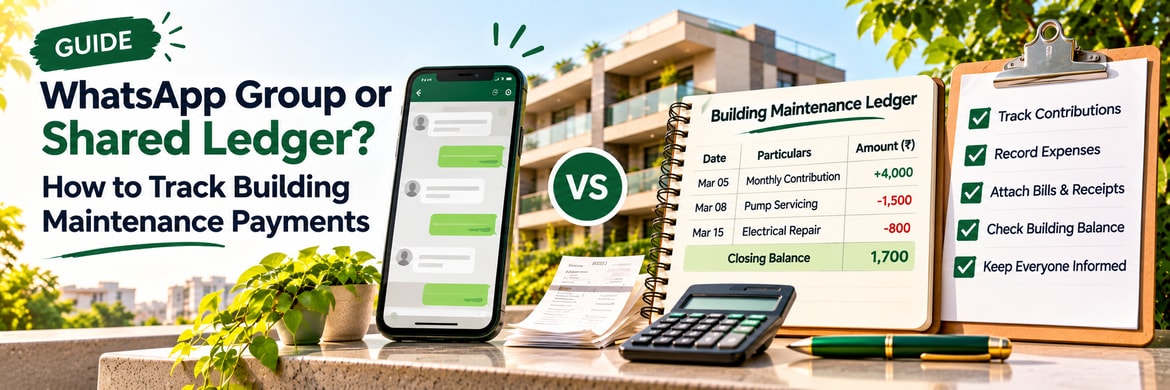
WhatsApp Group or Shared Ledger? How to Track Building Maintenance Payments
Introduction
In many independent builder-floor buildings, WhatsApp is the first place residents go when something needs attention.
The water pump stops working, someone shares a plumber's number, a lift repair is discussed, or a resident asks everyone to contribute towards staircase cleaning. A few messages later, someone shares a UPI QR code, residents make payments and screenshots start appearing in the group.
It works initially. But as months pass, things can get messy.
- Who has paid this month's maintenance contribution?
- How much money is left in the building account?
- Was the electrician paid last week?
- Where is the bill for the water pump repair?
- Did everyone contribute towards the terrace repair?
When all these details are buried inside hundreds of WhatsApp messages, finding accurate information becomes difficult.
The solution isn't necessarily to stop using WhatsApp. It's to give building finances a proper place of their own.
1. Why WhatsApp alone isn't enough for building maintenance
WhatsApp is excellent for conversations, quick updates and sharing information. However, it wasn't designed to maintain financial records.
Consider a building with four independent floors. Every month, residents contribute towards common maintenance expenses.
The group may contain:
- Payment screenshots from different residents
- Messages about pending contributions
- Repair quotations from electricians and plumbers
- Discussions about how expenses should be divided
- Bills and receipts shared as images
- Important decisions mixed with everyday conversations
After a few months, even a simple question like "How much did we spend on maintenance last month?" can require scrolling through a long chat history.
The problem isn't WhatsApp itself. The problem is using a conversation history as an accounting system.
2. Common problems with tracking payments through WhatsApp
A. Payment screenshots get lost
Residents share payment confirmations, but screenshots can disappear among other messages. Finding an old payment may require searching by date, amount or sender.
B. No clear monthly payment status
There may be no single view showing which floors have contributed and which payments are still pending.
C. Expenses are difficult to verify
A resident may share a message saying that ₹2,500 was spent on plumbing work. But where is the invoice? Who approved the work? Was the amount paid from the common building fund?
D. Building balance depends on one person's calculation
Often, one resident or coordinator maintains the total in a notebook or spreadsheet. If that person is unavailable, other residents may not know the current balance.
E. Previous records are difficult to access
A new tenant, owner or building coordinator may need information about previous repairs and payments. Reconstructing that history from WhatsApp messages is inconvenient.
3. What is a shared building maintenance ledger?
A shared building maintenance ledger is a central record of money collected and spent for common building activities.
Instead of relying on chat messages, residents can refer to one organised financial record.
A useful building ledger should track:
- Monthly maintenance contributions
- Payments received from each floor
- Pending contributions
- Common repair expenses
- Vendor payments
- Bills and receipts
- Opening and closing balances
- Previous months' financial history
For example, imagine a four-floor building where each household contributes ₹1,000 per month.
| Description | Amount |
|---|---|
| Floor 1 contribution | ₹1,000 |
| Floor 2 contribution | ₹1,000 |
| Floor 3 contribution | ₹1,000 |
| Floor 4 contribution | ₹1,000 |
| Total collected | ₹4,000 |
If ₹1,500 is spent on water pump maintenance, the ledger should show the expense and the remaining balance.
Opening balance: ₹0
Total collected: ₹4,000
Total expenses: ₹1,500
Closing balance: ₹2,500
Every resident can understand where the money came from and where it went.
This is an illustrative example. Actual contributions should follow the arrangement agreed upon by the building's residents or owners.
4. WhatsApp group vs shared building ledger
Both tools have their place. The goal is not to replace every conversation with software, but to use the right tool for the right purpose.
| Activity | WhatsApp group | Shared ledger |
|---|---|---|
| Discussing repair problems | Excellent | Not its main purpose |
| Sharing announcements | Excellent | Limited |
| Recording monthly contributions | Difficult | Excellent |
| Tracking pending payments | Manual | Organised |
| Recording repair expenses | Messages and screenshots | Structured entries |
| Maintaining bills and receipts | Difficult to organise | Can be attached to entries |
| Checking current balance | Requires calculation | Available in one view |
| Reviewing previous months | Time-consuming | Easy to access |
The ideal combination: Use WhatsApp for communication and a shared ledger for financial records.
5. What should a good building maintenance ledger include?
If residents want to maintain transparent records, these are the essential sections.
Monthly contributions
Record how much each household is expected to contribute, how much has been received and what remains pending.
Expense records
Every common expense should include:
- Expense description
- Amount paid
- Payment date
- Category (lift, water pump, cleaning, electricity, repairs, etc.)
- Vendor or service provider
- Supporting bill or receipt, wherever available
Building balance
Residents should be able to see how much money is available after accounting for collections and expenses.
Repair and maintenance history
Keep a record of recurring repairs, vendor details, previous quotations and completed work.
Resident access
Relevant residents should be able to view records without having to ask one person to share screenshots or spreadsheets.
6. How FloorMate can make building expense tracking easier
FloorMate is designed around the everyday needs of independent builder-floor buildings.
The idea is simple: residents should not need to maintain multiple spreadsheets, search old WhatsApp messages or depend on one person for every financial update.
With FloorMate, a building can organise its common activities in one place:
- Expense management: Record common building expenses and contributions.
- Maintenance tracking: Keep a record of repair work and maintenance activities.
- Shared ledger: Maintain an organised view of money collected and spent.
- Building communication: Discuss common works, celebrations and important building updates.
- Financial transparency: Give residents visibility into shared building records.
The objective is to make building management simpler—not to introduce complicated accounting processes.
And importantly, basic building management should remain accessible to residents without making them pay just to organise their own building.
7. A simple way to get started
You don't need to digitise everything on the first day.
Start with these five steps:
- Agree on how common expenses will be shared between residents.
- Record the opening balance, if the building already has a maintenance fund.
- List all monthly contributions and pending payments.
- Start recording every common expense with its bill or receipt.
- Review the ledger with residents at the end of every month.
Once residents get comfortable with the process, add maintenance schedules, vendor details and repair history.
Frequently Asked Questions
Is a WhatsApp group enough to manage building maintenance?
WhatsApp is useful for discussions and updates, but it can become difficult to manage payment records, receipts, expenses and balances through chat messages alone. A separate shared ledger is more suitable for financial tracking.
What is a building maintenance ledger?
A building maintenance ledger is a record of money collected and spent for common building expenses. It can include resident contributions, repair payments, vendor bills and the available balance.
Who should maintain the building maintenance accounts?
Residents can mutually decide who will coordinate the records. Ideally, financial entries and supporting documents should remain accessible to relevant residents so that the process does not depend entirely on one individual.
Can a small four-floor building maintain a shared ledger?
Absolutely. Even a small building with three or four households can benefit from organised records. A simple monthly contribution and expense tracker may be enough to start.
Should residents stop using WhatsApp for building communication?
No. WhatsApp remains useful for quick conversations and announcements. A shared ledger complements it by keeping financial information organised and easy to review.
How can residents avoid disputes over maintenance payments?
Agree on contribution rules in advance, record collections and expenses consistently, keep supporting bills and make financial records accessible to residents. Clear records can reduce misunderstandings, although residents should still discuss and resolve disagreements together.
Conclusion
WhatsApp makes communication easy, but building finances deserve something more organised.
When payment screenshots, repair bills and contribution discussions are scattered across messages, even a small building can struggle to maintain clear accounts.
A shared maintenance ledger gives residents a common view of their building's financial activity. It helps everyone understand what was collected, what was spent and what remains.
For independent builder-floor buildings, better records don't need to mean complicated management. They simply need to be accessible, consistent and transparent.
FloorMate aims to make that everyday building management easier—one building at a time.
Note: Maintenance contribution arrangements and financial responsibilities can vary depending on ownership documents, agreements and applicable laws. Residents should agree on appropriate arrangements for their building.